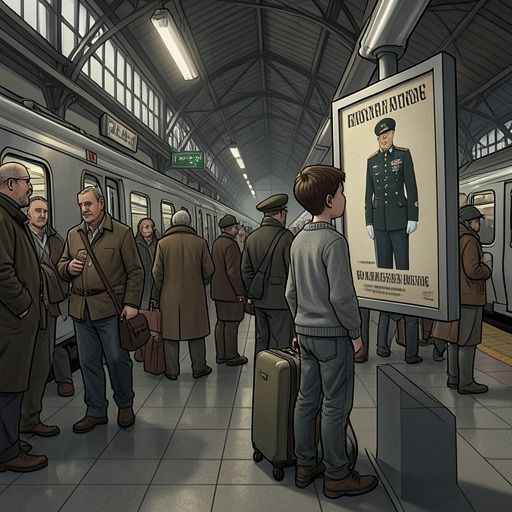
Adolf Hitler Schule
The Master Butchers Singing ClubAdolf Hitler Schule is the Nazi-era school attended by Emil Waldvogel and Erich Waldvogel. When the army urgently needed reinforcements, it took their entire class, including the teachers and platoon leaders. The school’s place in the story is therefore bound to the conversion of a cohort of students into soldiers and to the sharply different fates of the twins.
The School and Its Class
The novel gives no detailed account of the school’s curriculum or daily organization. It identifies the brothers as pupils there and shows the institution’s class being taken into military service as a group. Emil and Erich were singled out at the selection camp as officer material, an assessment that connects their schooling to a wartime system that rapidly turned students into recruits.
The Twins’ Different Fates
Emil’s combat service was brief. He died after stepping on a mine in a sheep pasture, before his new uniform had been worn in. The small objects associated with him—a photograph of Tante and a piece of honey candy carried at his grandmother’s insistence—remain in the narrative as family traces amid the abruptness of his death.
Erich continued fighting after Emil was killed. Constant shelling and the physical and emotional strain of combat overwhelmed the ideals he had sworn to uphold; after four sleepless days and nights, he was captured by American soldiers. His trajectory makes the school’s selection of both brothers as promising officers a grim prelude rather than a promise of glory.
Ideological Formation and Narrative Significance
The account of Erich’s later captivity describes him as having become thoroughly German in the sense he understood that identity: shaped by purity, loyalty unto death, and hostility toward weakness. He feared that using his American upbringing or becoming too friendly with Americans could endanger him, while rumors among prisoners reinforced suspicion of collaboration. The text does not establish the school as the sole source of this outlook, but places the brothers’ education within a wider process of wartime formation and indoctrination.
The school’s brief appearance carries weight through its consequences rather than through institutional description. Its entire class is swept into the army, and the brothers’ futures divide between Emil’s early death and Erich’s capture and ideological hardening. This contrast links education, collective mobilization, family loss, and the making of a militarized identity without presenting the school as an isolated cause of what follows.